Market and adoption decisions
Whether to enter, how to sequence, and what would have to be true. Delivered through the Market-to-Care method — evidence, buyers, workflow, culture, adoption.
About Miso
A London-based cross-border health-innovation studio. We connect strong women's-health innovation with the markets, care systems and people it needs to serve.
What we think is true
Health innovation rarely fails on the science. It fails in transit.
Evidence, legitimacy and trust are three different things. Each is earned separately, in each system, and holding one does not give you the others.
Language is not the last step of market entry. It is the mechanism by which people understand their own bodies.
A buyer's constraints are not an obstacle to the product. They are the specification for it.
Culture is not decoration on health. It decides what people will say out loud, and therefore what gets treated.
Medical linguistics
A product can be approved, funded and stocked, and still fail because nobody could explain it in terms the patient recognised. The gap opens between the trial and the clinician, the clinician and the patient, and one culture and the next.
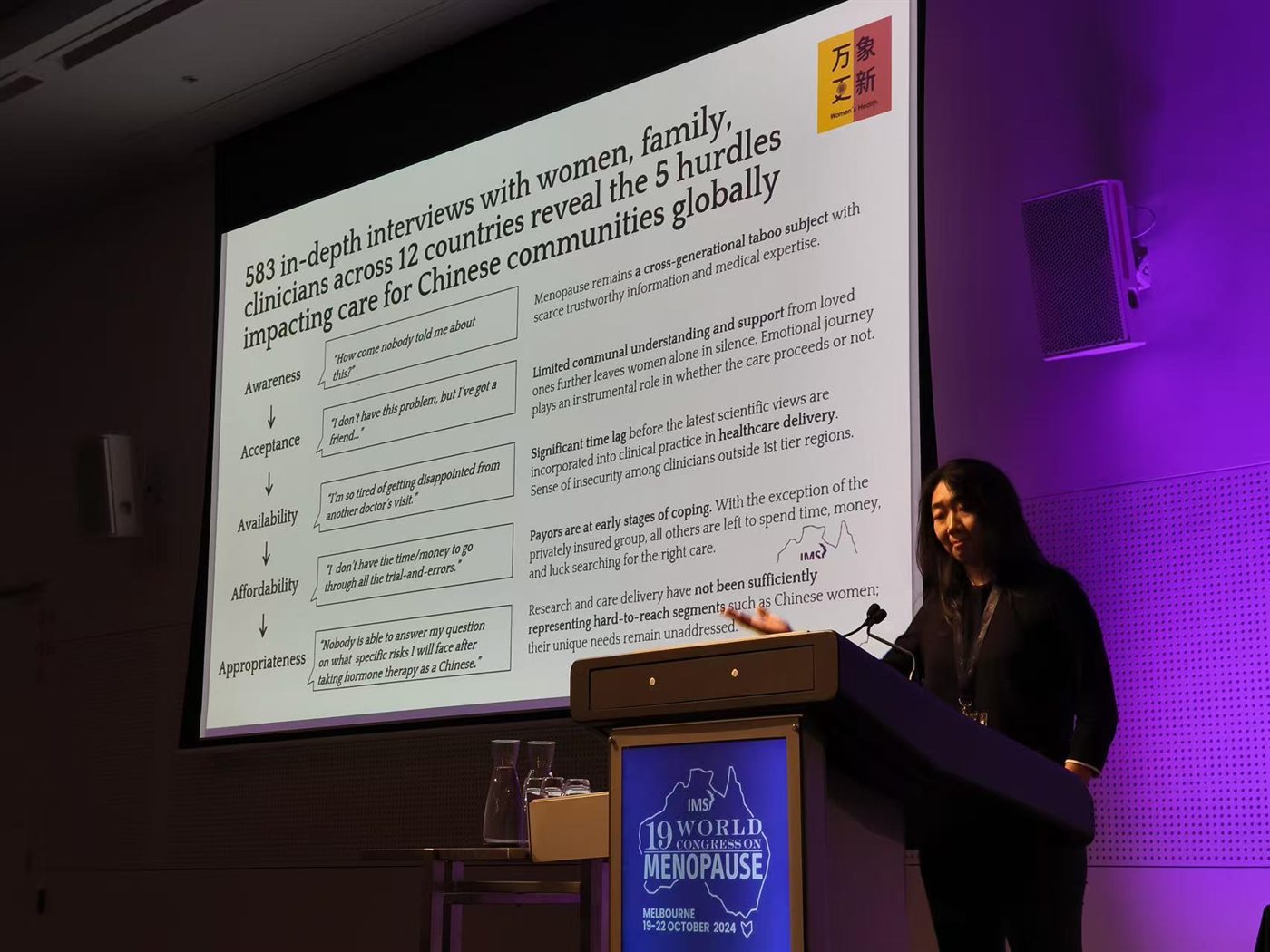
Miso closes it — clinical language turned into everyday language, adapted across cultures, and tested for whether people actually understood, in English and Mandarin. The work is grounded in an ongoing research programme with CeRLA at Université Lumière Lyon 2: corpus linguistics alongside interviews in twelve countries.
It has been applied at national scale. Nancy was an invited editor and co-author of the preface for China's first national menopause patient guideline, produced with Chinese Medical Association experts — the point at which how something is worded stops being editorial and starts shaping what clinicians tell patients.
Presented at the International Menopause Society World Congress, Melbourne, 2024; the Chinese Menopause Society, 2024; and the Asia-Pacific Menopause Federation, Kuala Lumpur, 2025.
Capabilities
Whether to enter, how to sequence, and what would have to be true. Delivered through the Market-to-Care method — evidence, buyers, workflow, culture, adoption.
Structured landscapes of a category, its regulatory and reimbursement conditions and the players in it. The APAC Health-AI Adoption Radar is a public worked example.
Turning clinical guidance and research into material that clinicians, patients or buyers will actually act on — across languages and health systems, not merely translated.
Designing the room and the agenda: expert panels, cross-sector sessions, cohort programmes and academic–industry formats that produce a decision rather than a discussion.
Direct reach into a Chinese-language health audience of scale, plus national magazine columns and a standing expert network — distribution most health-innovation advisers have to buy.
Mapping who has to agree, then building the relationships — clinicians, researchers, institutions, founders and public partners across APAC and Europe.
How the work is staffed

Clinicians, nurses, researchers, operators, artists and curators — deliberately from different disciplines, and most working across more than one health system and more than one language.
Practising specialists who pressure-test whether a claim survives contact with a real clinic, and who carry credibility with the clinicians a product needs.
The people who know which evidence a payer or regulator will actually accept in a given market, and what it costs to generate it.
Academic and applied researchers for protocol design, evidence synthesis and the linguistics of health communication across languages.
Operators who have run multi-market P&Ls, procurement and partnerships, and can judge whether a plan is executable rather than merely coherent.
Artists, curators and writers who can make a health subject approachable without making it trivial, and who reach people that clinical channels never do.
From the founder
My mother went through midlife while I was running chronic-care operations in twelve countries. Almost none of what I spent those years building ever reached her. Not because it did not exist — because nothing carried it the last few feet: into her language, into her clinic, into what she felt able to say out loud.
That is why Miso does things that do not obviously belong together — market strategy, clinical evidence, a podcast, an art exhibition. A product can clear the regulator and still fail in any one of them.